Know your reliability risks before you commit.
Revelara reads the change you are about to ship, finds the reliability risks in it, and grounds each one in the production failures that have already happened.
Grounded in a corpus of thousands of public production incident reports
CRITICAL
No circuit breaker on the downstream charge call
An unprotected call into a payment-path dependency does not fail alone. Requests pile up behind the sick dependency, the pool that serves the storefront drains, and customers see checkout errors on pages that never touched payments.
HIGH
Retries without backoff or jitter on the fulfilment call
Clients retrying in lockstep against a dependency that is already recovering supply enough load on their own to push it back down. The retry traffic becomes the outage, and it outlives the fault that started it.
MEDIUM
One-second cache TTL in front of a hot read path
A narrow key range concentrates reads onto a single database node, and a cache that expires faster than the query it fronts hands that load straight back instead of absorbing it. The hotspot and the short TTL are survivable apart and not together.
LOW
Health probe reports liveness only, not dependency health
Partial failure is worse than clean failure. A component that half-works keeps answering its probe, keeps being handed traffic, and keeps corrupting the picture upstream — the disruption routinely outlasts the fault underneath it by hours.
Sample project — the paths are invented, the patterns are not: each one is drawn from the corpus.
Runs inside the agent you already use
- Claude Code
- Cursor
- GitHub Copilot
- Gemini CLI
- OpenAI Codex
- Windsurf
- Cline
- Goose
- + 14 more
Every other reliability tool acts after the page. Observability detects. Incident tooling responds. Revelara works at code time, on the diff in front of you, and attaches the outage that already happened to somebody else.
Scan. Ask. Fix.
Before you commit.
Three steps, all of them inside the loop you already work in. Nothing new to open, nothing new to check.
/scanScan where you work
In Claude Code, Cursor, or Copilot, or the rvl CLI, point Revelara at the change you are about to commit. No dashboard to set up.
/askSee grounded findings
Get reliability risks in your code, many of them tied to a real public production incident that shows the failure the pattern already caused.
/fixFix before you commit
Handle the risk in the local dev loop, before CI and before it becomes a page. Go deeper with correlated, cross-service, and systemic analysis when you need it.
Two minutes on where reliability review fits.
From your repo to a ranked risk and back into your editor before a pull request exists, plus which kinds of risk each part of the platform reaches.
From code to confidence
in one workflow.
Revelara connects your incidents, architecture, and team knowledge into a continuous reliability loop.
Risks surface where you code
Install the CLI in 30 seconds. Revelara scans your codebase, maps risks, and delivers findings as slash commands right in your coding agent. No context switching, no dashboard to check.
-
/scan– Run a risk scan on your codebase -
/ask– Understand a finding before you act on it -
/fix– Get remediation guidance for a specific risk -
/risks– See open risks for the current project
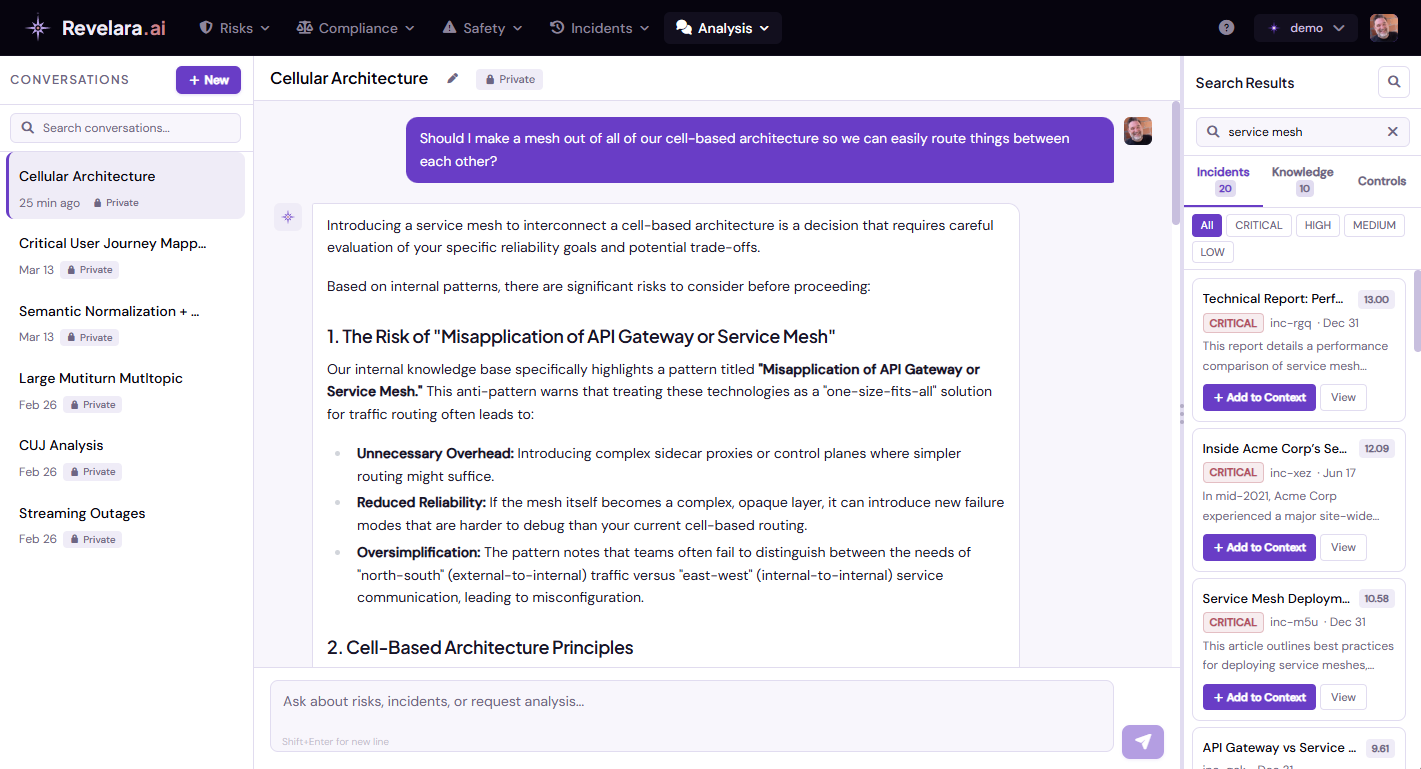
AI that learns from real incidents
Revelara matches your code against patterns from thousands of real-world incidents. Findings show their reasoning: what pattern was matched, what went wrong, and why it matters for your service.
- Cross-incident pattern analysis
- Many findings cite a real incident, not a generic rule
- Turns tribal knowledge into organizational muscle
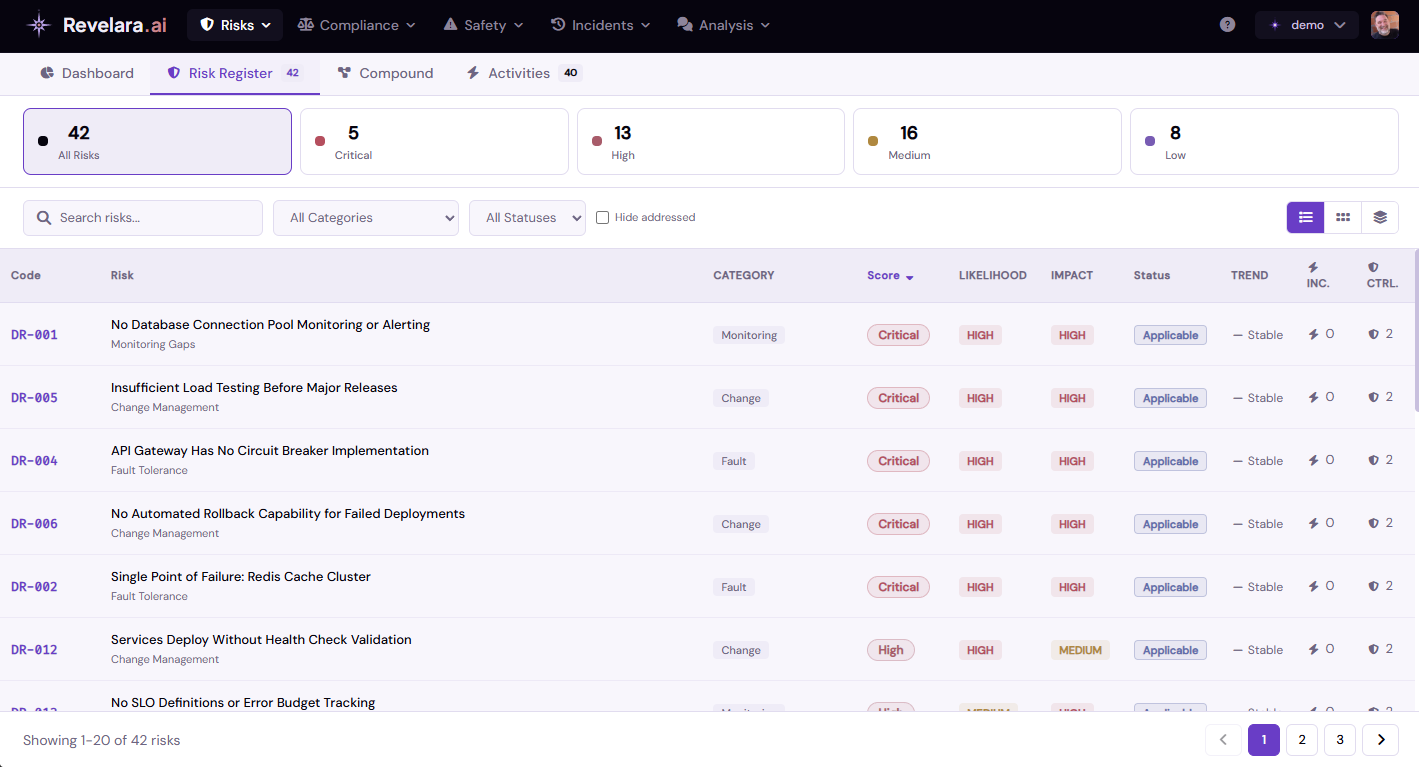
Map every reliability risk
Revelara continuously analyzes your reliability risks, classified by category, scored by severity, and linked to the services they affect. No more guessing what to prioritize.
- Auto-classified by category and severity
- Linked to services, teams, and controls
- Evidence coverage tracked automatically
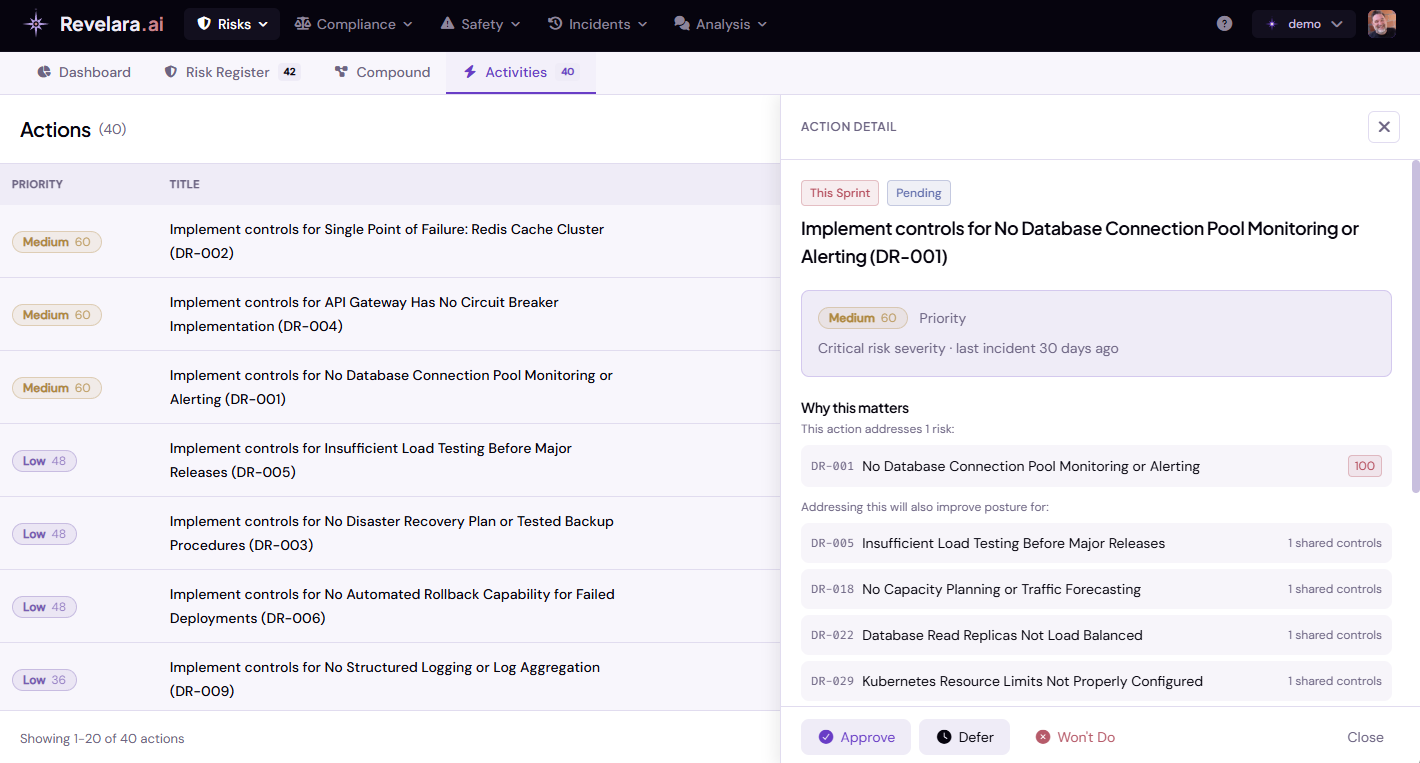
Ship controls, not tickets
Revelara turns risk findings into sprint-ready actions with embedded remediation controls. Approve, defer, or route to the right team, all from one place.
- Remediation embedded in coding agents
- Approve/defer workflow for control implementation
- Priority-scored to focus what matters most
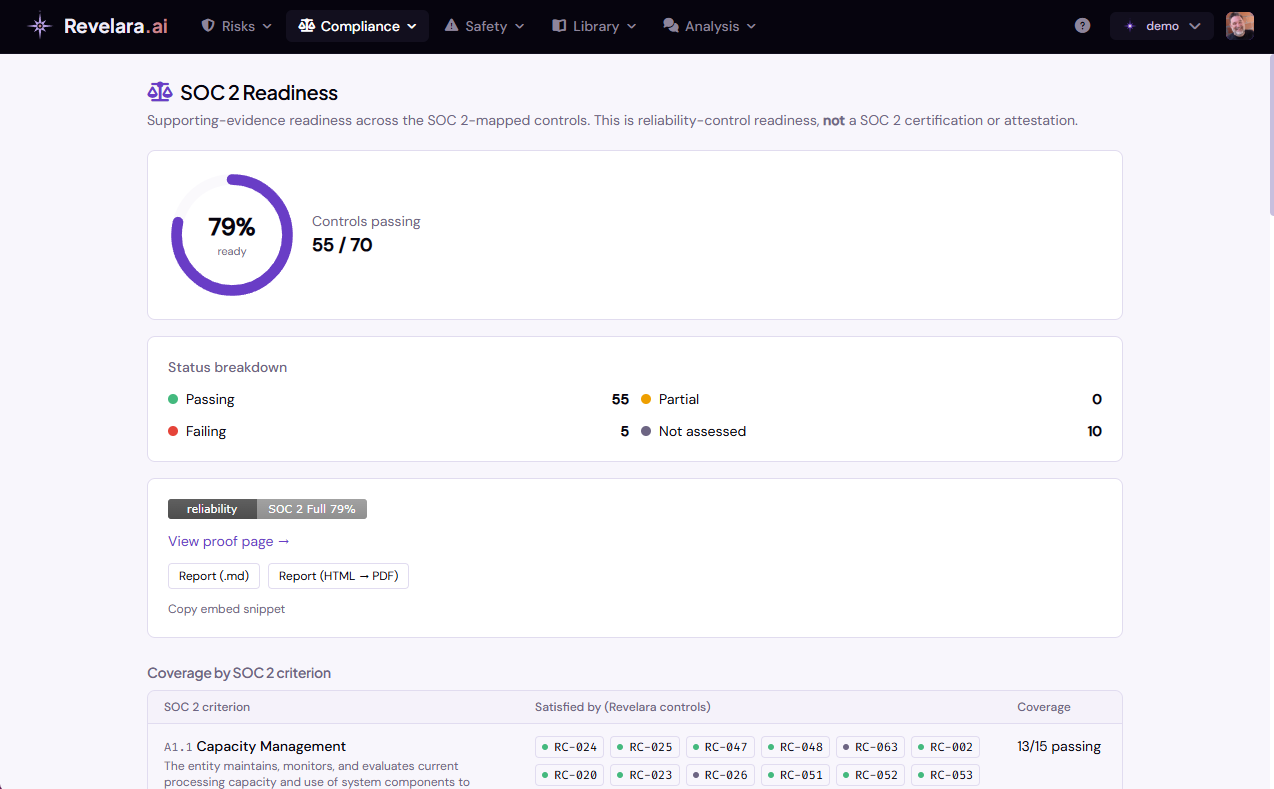
Turn reliability into audit evidence
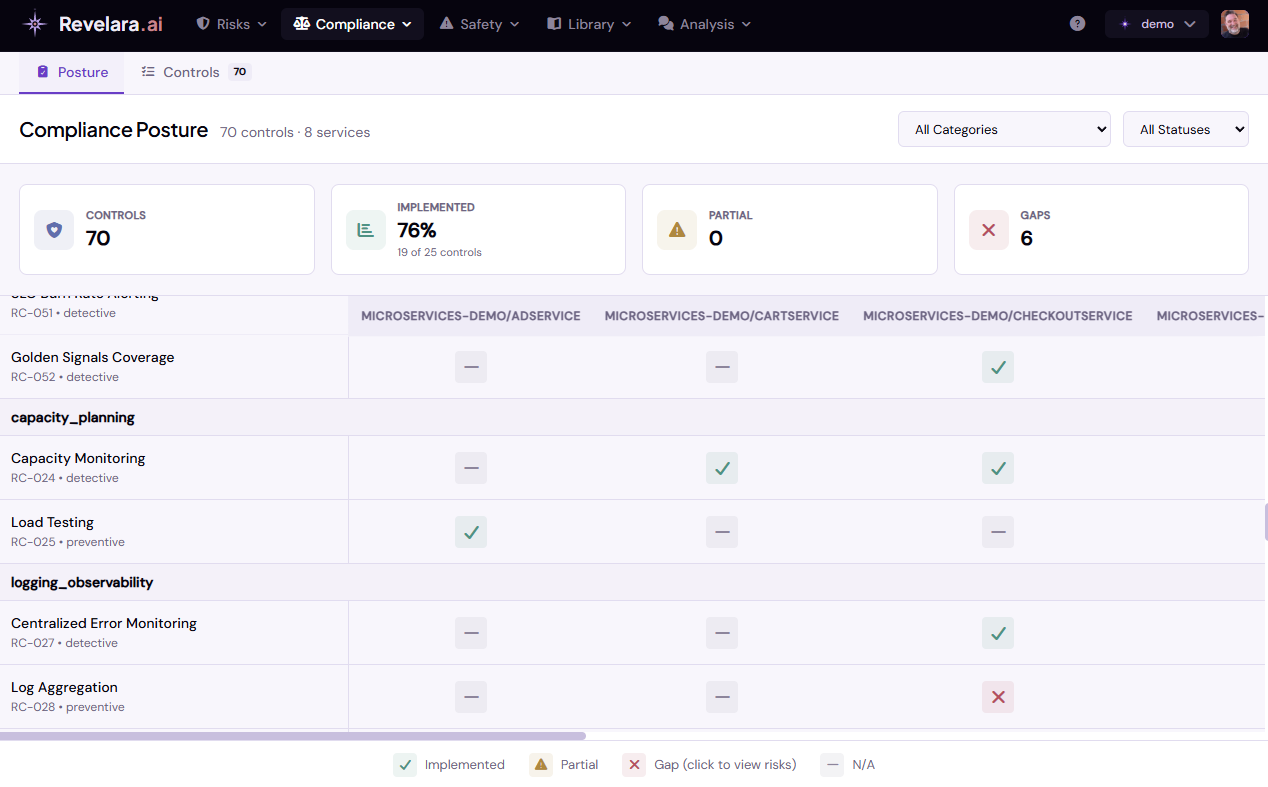
SOC 2's reliability controls live in engineering, not a compliance tool. Revelara maps them to the criteria they support and keeps the evidence current between audits.
- Coverage by criterion: Common Criteria, Availability
- A 70-control compliance matrix, highest-signal first
- Markdown, PDF, or a live proof page
Plugs into what you
already use.
Revelara installs over MCP, so it reaches your agent, your editor, and your issue tracker without a new place to log in.
The agents you already use
Revelara installs into your coding agent over MCP, plus a CLI and editor plugins. Point any MCP client at the Revelara MCP server and it can research incidents, risks, and controls while it works.
- Claude Code
- Cursor
- GitHub Copilot
- Google Gemini CLI
- OpenAI Codex
- Windsurf
- Cline
- Continue
- Goose
- Warp
- and 12 more
The data you already have
Connect your issue tracking and bring in your own postmortems. Your incident history becomes org-specific signal, isolated to your tenant, so the analysis tunes to the failures your team actually hits.
- GitHub
- Jira
- Linear
- Notion
- Confluence
Reliability coverage for
a team with no SRE.
Beyond code-time findings, Revelara gives an engineering leader a defensible reliability posture: 70 reliability controls, risk analysis, and compliance evidence, without hiring for a role that is hard to fill. It is coverage for a team that does not have a dedicated SRE, and it complements an SRE anywhere one already exists.
A posture you can put in front of a board
Every control maps to the services it covers, and every piece of evidence carries the change that produced it, so the picture is current rather than assembled the week before the review.
- Controls-to-services matrix
- Auto-generated evidence and coverage tracking
- Board-ready at any time
Thinking out loud
about reliability.
Posts on reliability work, the AI-generated code teams are shipping, and what the public postmortem corpus actually shows.
The Reliability Top 10, First Edition
Ten of the thirty-eight causal factors, ranked by the number of public incidents each appears in, across 1,287 incidents from 139 organizations. A reference for deciding where reliability effort goes, with the counting rules and the known biases stated alongside it.
Causal Factor Enumeration v1: The Full Catalog
All 38 contributing conditions in the first edition of the catalog, grouped into seven categories. Every entry has a stable CF identifier and its own link, so you can cite it.
Building a Causal Factor Enumeration for Reliability
Reliability has had outage taxonomies since 2003 and none became a shared vocabulary. This is an argument about why the earlier attempts didn't take hold, and the method behind a 38-entry catalog of contributing conditions based off of public incident disclosure data.
Ship with confidence.
Not hope.
Start your free 21-day trial. No credit card required.
We are careful with your code and transparent about how we handle it. See the security FAQ for exactly what Revelara reads, stores, and does not.
Want to talk sooner? Reach out directly.